

Zenith
New Member
July 28, 2013
Question

Spanning tree on software switch?

  • July 28, 2013
  • 9 replies
  • 22699 views
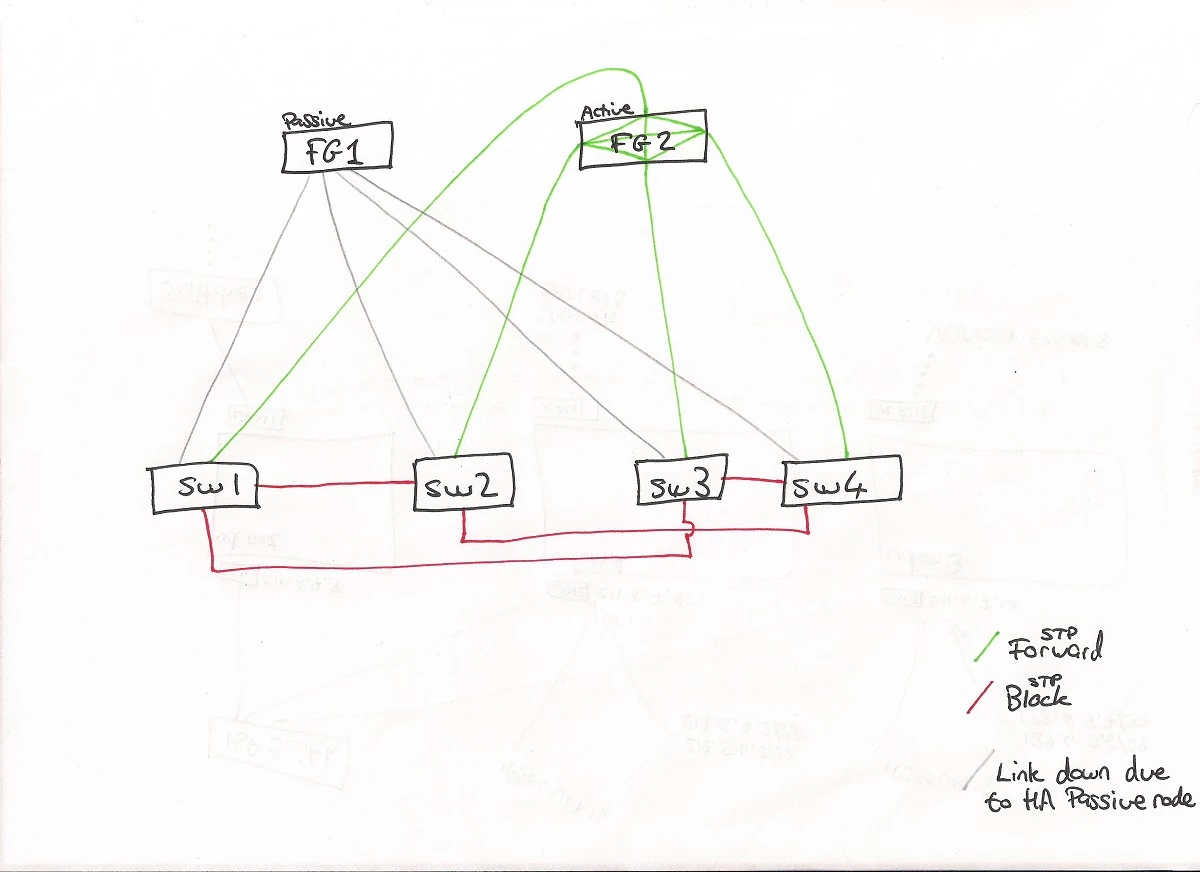
Hi guys, I' m new to a lot of these concepts so maybe I' m missing something obvious, but some input would be really appreciated! Basically I' m setting up a 100D HA pair (active/passive) and four 2960S switches in our datacentre. There will be one FGT and two switches per cabinet, with the cabinets linked by a ethernet connections. The idea being that in say cabinet A a host could have two NICs with one connected to each switch, so if a switch fails in a cabinet it' s no problem, and if a firewall fails in either cabinet it' s no problem. I have it all in-place and it' s working fine but I have a bit of a concern with how spanning-tree has set the links between the Cisco switches. I had envisaged lots of connections between all the switches and traffic could take the shortest route, but of course this routing not switching which became obvious when I started looking into STP . I' ve attached a diagram of how STP has enabled/disabled links. The FGT is configured with a four port software switch that the links from the four 2960s connect to. The problem in the attached diagram is that if servers on different switches want to talk to each other the traffic will be sent down the link to the FGT then back down another link to the relevant switch. It seems like a waste to take this route when there are (currently blocked) links between the switches themselves. The main thing I' m concerned about is the load it' s going to put on the FGT if it has to software-switch all possible traffic in the network. Now of course the good thing here is if a switch fails STP should bring up another link to the FGT, and in reality most of the traffic on the network will be from servers to the FGT (not too much inter-server traffic) but that could change. Is there a way to fix this or should I not be concerned in the first place? It seems like if I could stop the FGT acting as a switch then STP could enable all the inter-switch uplinks without creating loops and hence have more efficient paths between switches, however the software switch is kinda key to the various VLANs running across the switches :). Any thoughts?
    9 replies

    Bunce
    New Member
    July 29, 2013
    Have you looked at the ' Redundant Interface' feature of the Fortigate, rather than a software switch? It probably depends on whether you want to use Link Aggregation on the switches, but if not, you can set up the four interfaces on the FGT into a single ' Redundant Interface' which will in effect, just use one of the links unless there is a failure. Its documented pretty well in the HA guide. We' re setup similarly, but using just two switches and redundant interfaces to create the mesh. We also have an ISL between the two switches.
    romanr
    New Member
    July 29, 2013
    Hi, I already ran into the same trouble with the 100D " hardware switch" (which actually isn' t one, but thats some different story!) ... Spanning Tree Protocol is only present for the complete switch in " switch mode" . br, Roman
    Zenith
    ZenithAuthor
    New Member
    July 29, 2013
    Thanks for the replied guys, That' s a good idea on the redundant interfaces, we do not have a need for link aggregation. The problem then is that all traffic destined for the firewall will have to pass through the one switch that has the active link, which may not be a big deal when the firewall is just doing Internet access and server-server traffic is primarily switch-switch, however in our case the network will be quite heavily VLANed so a fair bit of the server-server traffic will be between VLANs meaning a trip through the firewall is required! Ideally if the FGT could stop allowing traffic between the four uplinks, unless that traffic is going between two separate VLANs/subnets/VDOMS, then you could have four active links from the switch to the FGT and also have three of those links between the switch live for any server-server traffic that is within a single VLAN and hence doesn' t need to hit the FGT. What solution did you come up with roman?
    rwpatterson
    New Member
    July 29, 2013
    Why don' t you stack the switches into pairs? You' ll then solve half your problems.
    Zenith
    ZenithAuthor
    New Member
    July 29, 2013
    rwpatterson - Cost unfortunately. For the size of the operation what we spent on this setup was already a stretch, stacking modules and the higher-end licences required for the switches was just too much.
    rwpatterson
    New Member
    July 29, 2013
    Makes sense. We use Alcatel here. The stacking modules are built in and the stacking cables are under a hundred bucks.... No additional software or licenses are needed.
    emnoc
    New Member
    July 29, 2013
    he probably has a lanlite license swicthes, so these don' t support flexstack nor have the ability to be upgraded. But yes that would solve any STP issues. Infact he could do multi-switch etherchannel and aggregated 1gigs to each switch if he had a flexstack stack. That' s how I typically deploy firewalls in a stacked environment.
    bigkeoni64
    Explorer II
    December 30, 2022

    Has this setup actually worked? Seems as though there would be some serious loops created and I would assume that each switch should have an LACP port-channel formed between FGT-1 & FGT-2. Also if the software switch is one big group - will it successfully form the LACP AGG with each switch?


    I've done this type of setup also on a different vendor FW, but with a 5 stack of Ruckus switches.

    Thought Leadership Security Summit. Outpace New Threats with AI - enhanced defense. Tuesday, Septmeber 15, 8:30 AM - 2:30 PM PT. The Golf Club at Newcastle, WA.
    Fortinet Flag the Hack. Wednesday, August 26, 9:00 AM - 5:00 PM ET, COSM, Atlanta, GA.
    Virtual event | September 2026. SASE summit. The age of autonomous trust. Register here!

