Hi @Ivan90 ,
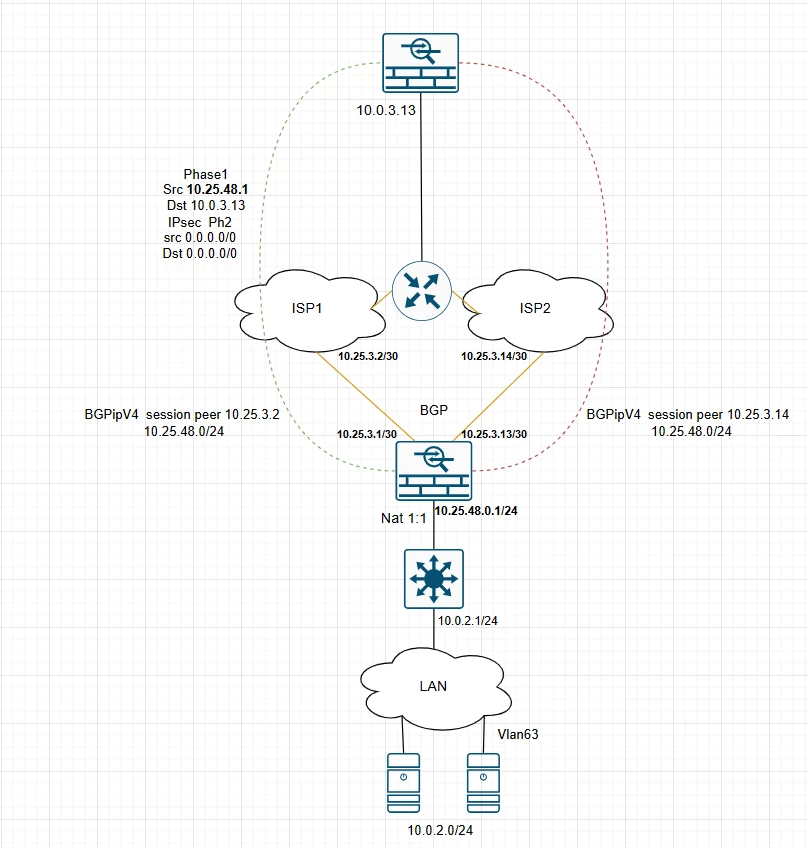
BGP runs between the FortiGate and the upstream router over both /30 links, advertising 10.25.48.0/24. Normal BGP best-path selection chooses the superior route—via ISP1 or ISP2—while the other link remains on standby. The partner uses a single public IP address (10.0.3.13) for the IPsec tunnel.
Assumptions:
WAN 1 = 10.25.3.1/30 → ISP1 router 10.25.3.2
WAN 2 = 10.25.3.13/30 → ISP2 router 10.25.3.14
DMZ/inside = 10.25.48.0/24 (FortiGate owns 10.25.48.1)
Partner IPsec peer = 10.0.3.13
We will tunnel any-to-any (0/0) traffic per partner’s spec.
1- (Optional) Add a loopback* with the source address (skip if 10.25.48.1 is already a primary/secondary IP on the FortiGate)
config system interface
edit loop0
set ip 10.25.48.1/32
set type loopback
next
end
2- Phase-1 interfaces (one per link): local-gw tells IKE to use 10.25.48.1 as the packet source even though the packets exit WAN1/WAN2.
config vpn ipsec phase1-interface
edit p1_wan1
set interface wan1
set remote-gw 10.0.3.13
set local-gw 10.25.48.1 # ‹— key line
set ike-version 2
set proposal aes256-sha256
set psksecret ENC <key>
next
edit p1_wan2
set interface wan2
set remote-gw 10.0.3.13
set local-gw 10.25.48.1 # ‹— key line
set ike-version 2
set proposal aes256-sha256
set psksecret ENC <key>
next
end
3- Phase-2 selectors (permit everything)
config vpn ipsec phase2-interface
edit p2_wan1
set phase1name p1_wan1
set src-subnet 0.0.0.0/0
set dst-subnet 0.0.0.0/0
set proposal aes256-sha256
next
edit p2_wan2
set phase1name p1_wan2
set src-subnet 0.0.0.0/0
set dst-subnet 0.0.0.0/0
set proposal aes256-sha256
next
end
4- Routing / fail-over: Primary BGP route to 10.0.3.13 makes to-partner-wan1 come up; if the route flips to WAN2, the same source IP keeps working and to-partner-wan2 becomes active.
5- Policies (policy-based IPsec): Create two identical policies—one per interface—matching the partner’s requirement.
6- Verification process
get vpn ipsec tunnel summary
execute ping-options source 10.25.48.1
execute ping 10.0.3.13
That setting 10.25.48.1 as the local-gw—whether on the DMZ interface or a loopback—is the supported way to originate the tunnel from that subnet, even though the traffic physically exits through WAN1 or WAN2. The FortiGate advertises 10.25.48.0/24 on both WAN links, and whichever path BGP prefers keeps Phase 1 active. No extra routing is required; the same local-gw works over either interface.
Caveat: Policy-based IPsec lacks built-in redundancy, so the standby tunnel stays idle until BGP switches routes. For faster, smoother failover, consider migrating to route-based IPsec with SD-WAN.
BR.
If my answer provided a solution for you, please mark the reply as solved it so that others can get it easily while searching for similar scenarios.
CCIE #68781