The advantage of an interface is that this logical interface is always up (no physical link dependency) and the attached subnets are always present in the routing table.
It allows connections to the FortiGate's loopback IP address without depending on one specific external port, and it is therefore possible to access it through several physical or VLAN interfaces (redundancy).
Multiple loopback interfaces can be configured in either non-VDOM mode or in each VDOM.
Note: Using loopback interfaces requires the configuration of appropriate firewall policies to allow traffic to and from this (those) interface(s).
The traffic initiated from the FortiGate will not need a firewall policy as it is processed as local-out traffic. For the packets with destination the loopback interface a firewall policy allowing the traffic is essential.
Some scenarios where a loopback interface can be used: Dynamic routing protocols can be enabled on loopback interfaces. For the blackhole static route, use the blackhole route type instead of the loopback interface.
Configuration example:
config system interface
    edit "Loopback0"
        set vdom "root"
        set ip 192.168.100.1 255.255.255.255
        set type loopback
        set allowaccess ping https ssh
        set status enable
    next
end
BGP peering and Management access scenario:
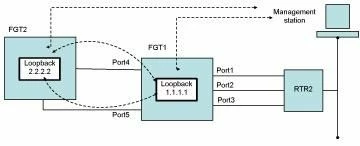 The loopback interface is seen from the routing table as a connected interface:
FGT1 # get router info routing-table all

[......]

C       10.0.0.2/32 is directly connected, loopback
[......]
FGT2 and FGT1 can establish an iBGP peering to their respective loopback interface via Port4 or Port5 (routing and firewall policies must permit). The Management station has only single IP addresses for FGT1 and FGT2, that can be accessed from any interface and routed by RTR2 (routing and firewall policies must permit).
Configuring a loopback interface on FortiGate provides a flexible and reliable way to manage routing, VPNs, and administrative tasks. It is especially useful in complex network designs for better redundancy and stability.
See more details about BGP peering with a loopback interface in the related article at the end of this page.
Related articles: |