


A basic explanation of EAP
Description
A simplified explanation of how EAP methods broadly work.
Scope
FortiClient, FortiAP, FortiGate, FortiWifi, FortiAuthenticator.
Solution
EAP (Extensible Authentication Protocol) is an authentication framework that provides some functions and negotiation options collectively called EAP methods. It is frequently used in WiFi or Ethernet authentication (WPA2/WPA3-Enterprise, 802.1x standard), as well as IPsec IKEv2 tunnels.
In general, an EAP method is used to provide a secure authentication option over an otherwise insecure medium, and, depending on the EAP method, may involve server/client certificates and/or user credentials.
Some of the more common methods are:
EAP-TTLS: Validates user credentials with cleartext password.
(P)EAP-MSCHAPv2: Validates user credentials with hashed password.
EAP-TLS: Validates a client certificate rather than credentials.
EAP-TEAP: Combines user credentials and machine authentication (certificate).
There are three participants in an EAP authentication:
Supplicant | NAS | Authentication Server |
|---|---|---|
The connecting client; for example a computer connecting to WiFi or a VPN client connecting to a VPN gateway | Network Access Server; the device/application the client is trying to get access to, such as the wireless controller or VPN gateway | The server that validates the user's credentials and/or certificate. |
 |  |  |
EAP broadly includes the following steps:
The supplicant contacts the NAS.

The supplicant provides an initial authentication request/EAP message to the NAS.

The NAS forwards the request to the authentication server.

The authentication server prepares a reply message for the the supplicant.
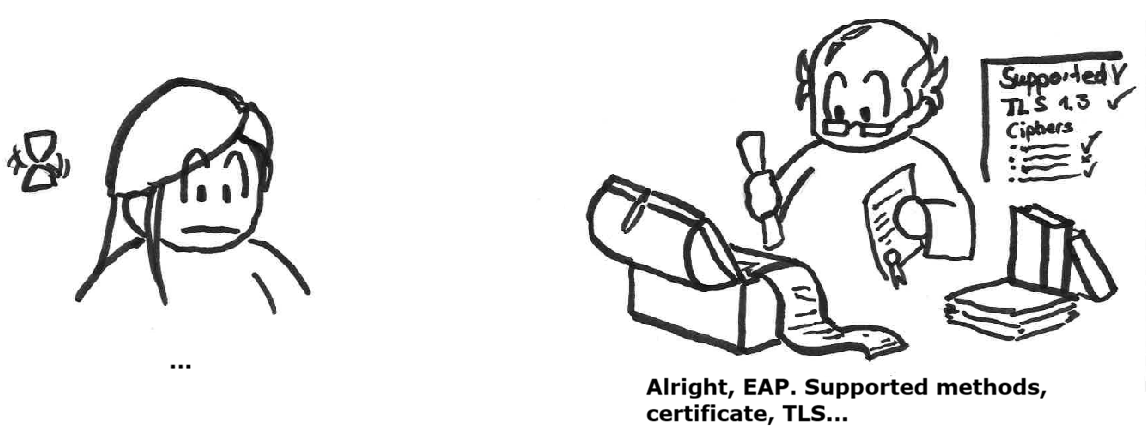
Note: This usually includes things like server certificate and supported TLS versions.
The supplicant checks the message from the authentication server.

Note: As the NAS has no insight into the actual EAP communication, it may apply more strict timeouts.
Supplicant and authentication server exchange multiple messages, with the NAS acting as proxy but not influencing the messages.

Note: This may include steps such as client certificate checks, user credential validation, and second factor.
Once the authentication is completed, the authentication server informs the NAS of it and provides any required details like group membership.

The NAS allows access to the supplicant.

Related documentation:
