


Technical Tip: OSPF areas
Description | This article describes the OSPF areas. |
Scope | FortiGate. |
Solution | An area is a logical collection of network devices, sharing identical information about the topology of that area. Multi-area OSPF is a hierarchical design, dividing networks into multiple areas to streamline traffic and reduce overhead. 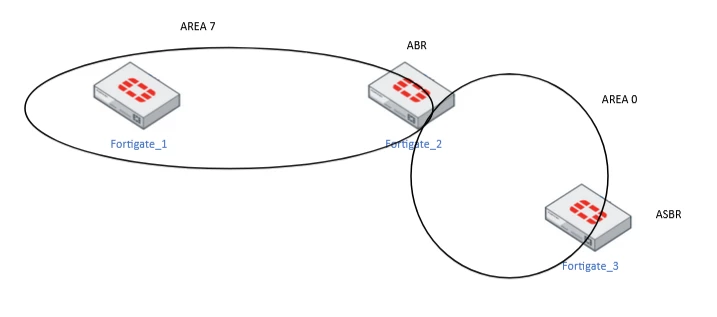
This design significantly improves network efficiency by limiting traffic updates within the boundaries of each area.
Areas are identified by an Area ID, the Backbone area is identified by the number '0' or '0.0.0.0', and non-backbone areas can be given any area ID. Each area must have an Area border router (ABR) that connects to the backbone area, Area 0.
The ABR is responsible for maintaining the topology in sync with the other routers that are fully adjacent to it, meaning all the routers in that area must have an identical link-state information/database.
OSPF areas are groupings of OSPF routers or logical parts of a network. An area's routing information can be sent as a summary to other areas.
ABRs may learn routes to other areas from the backbone area, and as well advertise their database or choose to advertise a summary of the database. Hence, summarization of routes is only possible on an ABR in an OSPF domain.
ASBR is a router that connects an OSPF autonomous system to the external network. The route to reach the ASBR is shared by the ABR of each area. Router roles in a multi-area design:
Stub areas are areas that cannot receive external routes. Some stub areas, such as stub areas and not-so-stubby areas (NSSA) can import external routes but not receive them from other areas, whereas others, such as totally-stubby areas (TSA), do not receive any summary or external routes at all.
Stub areas generally use default routes to send traffic over external routes, which means the routers must send a packet to the ABR to reach the ASBR, no matter what the external destination.
In the stub areas, the external LSA and ASBR external LSA are not allowed. It will allow only the router LSA and the network LSA with the summary LSA.
|